
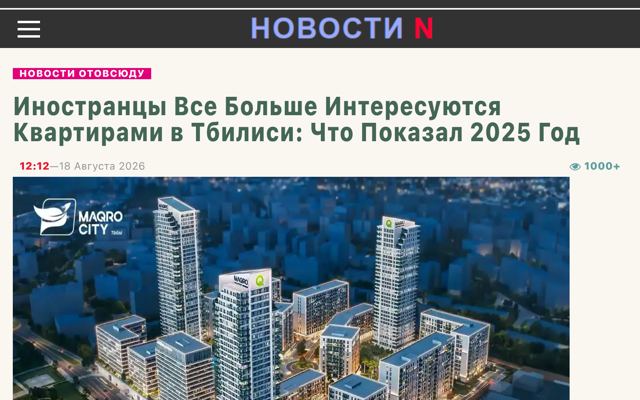
The Georgian real estate market continues to show impressive results. By the end of 2025, Georgia's real estate market volume reached 3.57 billion dollars with overall growth of 12.6% compared to the previous year. Meanwhile, the country's capital Tbilisi remains the epicenter of activity: the number of concluded transactions here reached 42,388 contracts. The most significant trend was the growth of the primary market — new construction sales jumped by 27.3%, which indicates an expansion of construction activity and stable demand for new housing.
Particularly noteworthy is that demand is increasingly driven by foreign investors. According to developer survey data, in 2025 foreign buyers concluded approximately 23% of all apartment transactions in the capital — this is higher than the 2024 figure, when their share was 20%. Such dynamic growth of foreign capital into the Georgian housing market is not accidental — it is driven by several specific factors that make investments in Tbilisi attractive to foreign buyers.
High Returns Amid Regional Competition
The primary and one of the main reasons to purchase real estate in Tbilisi is the opportunity to earn stable passive income. According to a report by analytical agency Galf&Taggart for 2025, rental income in Tbilisi averages approximately 8.6% annually — this is the third highest result among twelve regional capitals. For comparison: in Baltic capitals (Riga and Tallinn), returns range from 3.6–4.4%, in Yerevan — 6.6%, in Baku — 5.3%. This means that a Tbilisi apartment pays for itself almost twice as fast as comparable real estate in Baltic cities. With an average rental rate of $9.8 per square meter and sustained stable demand for apartments for rent, the investment returns look quite attractive.
Favorable Tax Policy and Visa Regime
The second reason is a favorable tax environment. Georgia deliberately attracts foreign capital: the purchase of real estate by an individual is not taxed at all, and the tax on income from renting out apartments is only 5%. This means that a foreign owner can keep almost all rental income in their pocket. At the same time, for non-residents, the conditions for purchasing real estate are practically no different from those for local citizens — there are no quotas, premiums, or restrictions on residential real estate. The only restriction concerns only agricultural land.
The third significant factor relates to the opportunity to obtain a residence permit through real estate investment. As of March 1, 2026, the minimum purchase threshold for obtaining a residence permit is set at 150,000 dollars. Thus, an apartment becomes both an income-generating asset and a basis for official residence in the country — this is particularly attractive for entrepreneurs considering the possibility of working in the region.
Convenience of Remote Purchase and Favorable Financing
The fourth reason lies in the simplicity and convenience of the purchasing process. Even from outside Georgia, an investor can complete the entire transaction remotely. The country's legislation does not provide any obstacles to signing a preliminary contract remotely if the developer agrees — personal presence is required only for the final registration in the registry. Moreover, a foreign buyer can bypass the bank entirely: instead of traditional mortgage financing, you can arrange interest-free internal installment payments directly from the developer (if purchasing an apartment in a property that is still under construction).
Premium Projects as Demand Drivers
This foreign demand is reflected in the development of large new construction projects that are specifically designed to meet the needs of remote investors. A notable example is the premium project Maqro City Tbilisi — a large residential complex with 4,000 apartments in 17 buildings, occupying 100,000 m². The distinctive feature of this project is that almost half of the territory, namely 45,169 m², is dedicated to recreation areas. The enclosed territory, security system, and various amenities (four swimming pools, three tennis courts, fitness zones, and an on-site kindergarten) create demand for apartments among tenants and, consequently, increase the profitability of the entire complex.
An important point — in this complex, apartments are handed over fully renovated with finished decoration, including laminate flooring, underfloor heating, and a kitchen with built-in appliances. This spares the remote owner from the need to organize renovation from another country. For comparison: typically apartments in Tbilisi are rented out either with a white shell or with premium "green" renovation, but move-in-ready options are rare.
The combination of all these factors — returns of 8.6%, rental tax of only 5%, the opportunity to obtain a residence permit from 150,000 dollars, and the convenience of remote purchase with installment payments from 10% — creates a quite compelling investment case. Foreign investors are making a rational choice, rushing to invest in a market that so far shows no signs of cooling and maintains returns higher than competing regional capitals.